Workshop & storage: what method avoids the catch-all bin?
Hello, this is Kyl. The simplest way to avoid a catch-all bin is to sort by use, then assign a fixed place to each category. Methodical storage clears the workbench and makes tools easier to find. The principle can be summed up in a few words: “A place for everything, and everything in its place.”
What to do now:
- Empty the catch-all bin onto a sorting surface.
- Group items by category: tools, fasteners, consumables, and hazardous products.
- Set aside anything broken, duplicated, or unused.
- Choose a fixed place based on how often each item is used.
- Prepare suitable containers and easy-to-read labels.
To take this approach further, you can consult a guide on choosing labels for your stock and tips on how to organize your workshop like a professional.
Workshop organization: sort before choosing storage
Start by looking at what you actually use. A tool you reach for every session should stay near the workbench; a spare part can be stored farther away. This sorting by category prevents you from buying furniture before you know what you need.
Also set aside an area for decluttering. Remove anything unusable, then group duplicates and similar items together. A common workshop anecdote: a box of mixed screws seems handy at first, until the day you need to find a specific length in the middle of a project.
Define four useful storage zones
Organize your equipment according to how often it is used and any precautions required. This approach makes the storage zones easy to understand, even when several people share the space.
- Zone A, immediate access: tools used every session, near the workstation.
- Zone B, convenient access: tools and consumables used regularly.
- Zone C, storage: occasional-use equipment, spare parts, and complete tool kits.
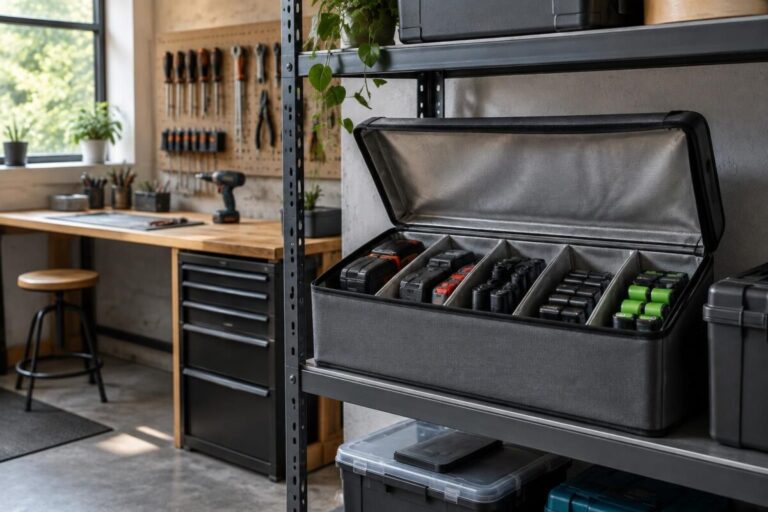
- Zone D, safety: hazardous products, solvents, aerosols, and batteries, stored separately according to their instructions.
Keep frequently used tools within reach, without needing a step stool. Heavy items belong down low, and hazardous products should not be mixed with everyday consumables.
Vertical storage: clear the workbench without losing access
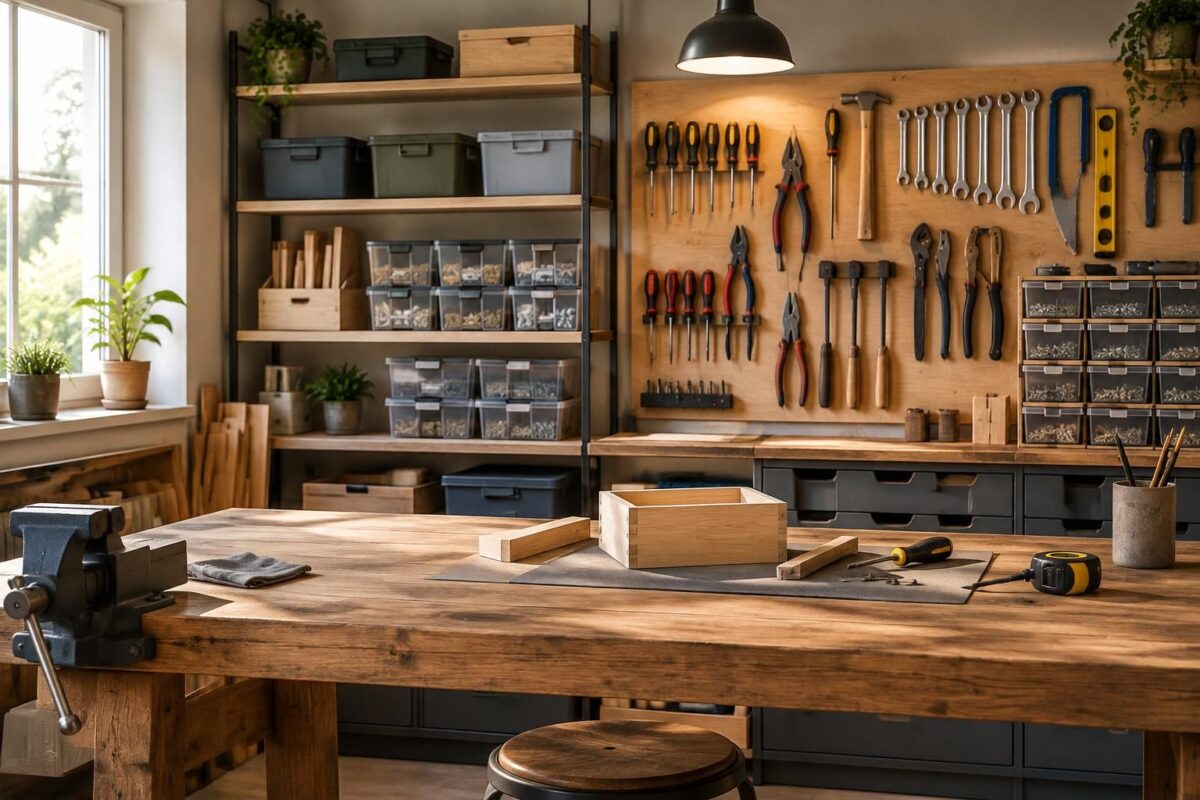
Walls often offer underused storage space. A pegboard, some rails, and a few holders let you hang hand tools and clear the work surface.
Before installing anything, check the type of wall and choose suitable fixings. Keep frequently used items at a comfortable height; reserve higher areas for lightweight, occasional-use equipment. Vertical storage only works if every tool remains accessible and securely held in place.
For small parts, use labeled boxes or a compartmentalized toolbox. Clear bins make it easier to spot their contents quickly; closed containers offer better protection from dust and moisture.
A three-step method to avoid the catch-all bin
The method is simple: sort, assign a place, then maintain order. A typical workshop can often be reorganized over a weekend, depending on how much there is to sort and what needs to be installed.
- Step 1 — Sort: empty the bin and separate tools, consumables, parts, waste, and items to check. Don’t put anything back in the bin without deciding what it’s for.
- Step 2 — Assign a place: store items according to how often they’re used and any risks they pose. Put small parts in compartments, then label each container with a simple name.
- Step 3 — Make it stick: after each session, put tools back in their places and note which storage solutions aren’t working. Change a location if you constantly have to move other items to access it.
The secret isn’t to organize everything perfectly once, but to reduce the number of decisions you have to make afterward. A two-minute tidy-up at the end of each session is often enough to keep the clutter from coming back.
Choose furniture based on use and safety
A rolling tool chest is ideal for tools that move around the workbench with you. Drawers organize small parts, while a closed cabinet protects certain products and helps prevent them from getting mixed together. Heavy loads should be kept in low, stable storage.
| Need | Suitable solution | Practical tip |
|---|---|---|
| Frequently used tools | Rail or wall-mounted panel | Within reach, near the workstation |
| Fasteners and small components | Drawers or compartmentalized bins | Visible labels and separate categories |
| Occasional-use equipment | Shallow shelves | Keep lightweight items up high |
| Hazardous products | Suitable, separate cabinet | Follow storage instructions |
| Mobile work | Rolling tool chest with drawers | Keep tools grouped near the active work area |
Keep walkways clear and move boxes away from cables and heat sources. Safe storage also makes it easier to evacuate quickly: nothing should block a door or passageway.
Two situations, two priorities
If your workshop is small, make use of the walls, stackable bins, and shallow shelves. If several people use the same tools, standardize the labels and keep instructions visible.
In a shared workshop, a photo or pictogram on a bin can prevent confusion between similar-looking parts. Labels make shared routines easier to communicate.
Maintain a lasting storage system
A lasting storage system adapts to the work you actually do. If a tool keeps getting moved, its location is probably poorly chosen; move it closer to the workstation or change its holder.
At the end of each session, put the Zone A tools back in place, close the containers, and clear scraps from the workbench. This small routine keeps the work surface ready for the next task and makes it easier to notice what’s missing.
How do I start organizing a cluttered workshop?
Empty the catch-all bin, sort items into categories, then assign a fixed place to each group before buying new storage.
What storage should I choose for small parts?
Use drawers or compartmentalized bins with easy-to-read labels. Separate similar parts to avoid mistakes and lengthy searches.
Where should I put the most frequently used tools?
Keep them near the workstation, at a height you can reach without a step stool. Heavy tools should be kept in low, stable storage.
How can I stop the clutter from coming back?
Set aside two minutes to tidy up after each session, put every tool back in its place, and adjust any locations that make items difficult to access.
Thank you for your interest; Kyl